 Astra Nora

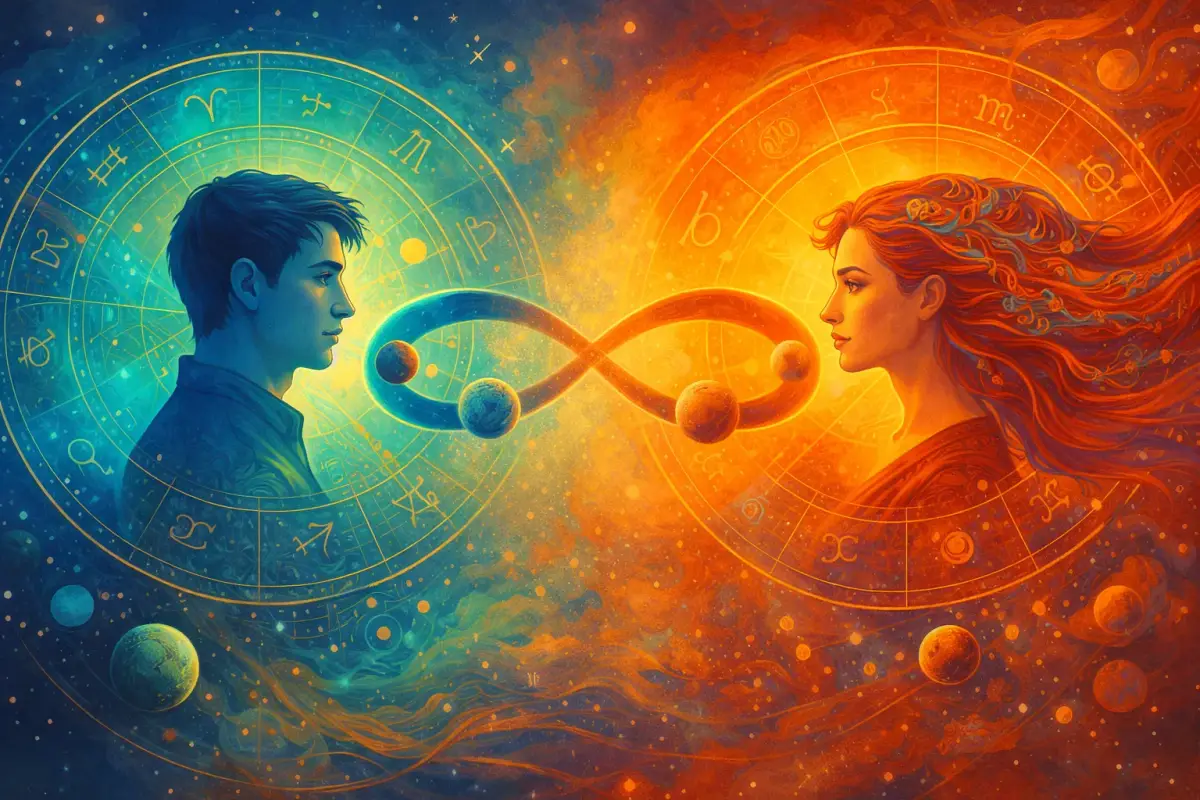
When Opposites Orbit: Practical Synastry for Very Different Charts
Compatibility isn’t a test of how much two charts match; it’s a map of how two ways of being meet, negotiate, and either create safety or rehearse old wounds. In practice, relationships are energetic conversations — sometimes harmonious, sometimes dissonant — and a useful reading focuses on interaction, not on whether two charts look identical.
Astra Nora approaches compatibility as both technical astrology and lived psychology: the natal chart gives the terrain, synastry and composite charts show the choreography, and additional systems like Human Design and Vedic astrology add refinement around decision‑making and emotional timing. Below I outline clear techniques and interpretive moves to make sense of very different charts, with examples you can try in conversation.
Why 'Different' Charts Can Still Be Compatible
Start with three definitions:
- Natal chart: a map of planetary placements at birth that describes needs, drives, and temperament.
- Synastry: a comparison of two natal charts that shows how planets interact across charts — the relationship between Person A’s planets and Person B’s chart.
- Composite chart: a midpoint chart that represents the relationship itself — the couple as an entity with its own identity and emotional life.
Key energetic roles
- Sun & Ascendant: core identity and how one appears in relationship.
- Moon: emotional needs and safety.
- Venus & Mars: attraction, love style, and desire/drive.
- Personal planets (Mercury, Venus, Mars) show the day‑to‑day style of relating and communicating; slow planets (Saturn, Uranus, Neptune, Pluto, Chiron) shape long‑term tests, awakenings, and healing.
Why difference can be useful
- Complementary skills: one partner’s initiative can pair well with the other’s steadiness.
- Attraction through polarity: contrast can magnetize (e.g., active fire meeting receptive water).
- Growth edges: friction often reveals needs to be met; naming those needs is therapeutic work.
Psychological context
- Differences trigger projection and unmet needs. Reading compatibility is technical (aspects, rulers, houses) and therapeutic (naming needs, negotiating boundaries, building safety).
Key Techniques to Read Compatibility
-
Prioritize luminaries and angles
- Read Sun, Moon, Ascendant, Descendant first: they structure identity, emotional life, and relational roles.
-
Check personal planets
- Venus for values/attraction; Mars for assertion/drive; Mercury for how you talk about things. These reveal daily compatibility.
-
Map major synastry aspects
- Conjunctions intensify shared focus.
- Oppositions create polarity and mutual reflection.
- Squares generate friction that can catalyze action.
- Trines/sextiles facilitate ease and natural understanding.
-
House overlays
- Where one person’s planets land in the other’s houses shows life areas that get activated (e.g., partner’s Sun in your 4th brings focus to home/family).
-
Rulerships and dispositor chains
- Follow house rulers and dispositors to uncover indirect connections that aren’t obvious at first glance.
-
Read the composite chart
- Composite Sun and Ascendant describe the couple’s shared identity; composite Moon indicates the relationship’s emotional mood.
-
Slow planets and hard points
- Saturn, Uranus, Neptune, Pluto, Chiron in synastry and composite show long‑term themes: tests, awakenings, erosions, transformations, and healing.
-
Element and modality balance
- Air vs Earth, Fire vs Water: if one chart is heavy in air and the other earth, focus on mechanisms that translate ideas into action (Mercury to Saturn/Mars links, for example).
Practical example for beginners
- If one chart is air‑dominant (ideas, conversation) and the other earth‑dominant (practical, embodied), look for Mercury or Mars linking to Saturn or Venus to see how thinking becomes tangible — that link will often determine whether plans stick.
Step-by-Step Approach When Charts Look Very Different
This is a conceptual workflow to organize your reading and your conversation with a partner:
-
Begin with essentials
- Compare Sun, Moon, Ascendant, Venus, Mars to identify where identity, needs, and attraction sit.
-
Identify 2–3 central themes
- Choose themes such as emotional safety (Moon), attraction/values (Venus/Mars), and roles or public perception (Sun/Asc/Desc).
-
Map tension and ease
- Mark squares and oppositions for recurring friction; trines and sextiles for areas of flow. Ask: does a tension feel like growth or threat?
-
Read house overlays for lived expression
- See where differences show up in daily life (2nd/6th/7th house) versus public roles (10th/11th house).
-
Look for practical compensations
- Hard aspects to slow planets may mean long lessons but also structure. Softeners (e.g., a trine to Venus) can ease daily interaction.
-
Form compassionate hypotheses
- Translate astrological data into relational language and invite experiment: “When your Moon squares their Mars, you may feel triggered by their assertiveness; can we create a pause strategy?”
Interpretive script you can use
- “When your Moon squares their Mars, you may feel emotionally triggered by their assertiveness. Naming the trigger and agreeing on a short pause (breathing, stepping back, scheduled check‑ins) helps both partners regulate and preserve connection.”
Emotional and Psychological Dynamics to Look For
Go beyond symbols; look for how patterns feel in real life.
Common dynamics
-
Projection and unmet needs
- When a partner’s Moon is unsupported, others may become containers for unmet emotional needs.
-
Attachment and safety
- Saturn contacts can indicate fears around commitment or a stabilizing promise — depending on context, this is either supportive structure or a constricting pattern.
-
Wounding and healing
- Chiron and hard Pluto connections often bring up old wounds; these can be opportunities for deep healing if both parties take responsibility.
-
Energizing vs draining patterns
- A fire‑heavy chart may inspire, but a water‑heavy partner can be depleted if overstimulated. Look for compensatory rhythms.
-
Roles and expectations
- Ascendant/Descendant and house overlays often reveal who naturally takes initiative, caretaking, or boundary work.
Practical emotional strategies
- Name triggers aloud and non‑judgmentally.
- Create micro‑rituals for regulation (breath, brief time‑outs, agreed check‑ins).
- Translate astrology into conversation starters that respect needs: “When you withdraw, I feel abandoned—your Moon in Capricorn suggests you process privately; can we plan a quick check‑in so I feel seen?”
Lived example
- I worked with a couple where one person's Moon was in Scorpio and the other's Mars was in Leo. Emotional intensity plus dramatic assertion repeatedly escalated. When they learned to reframe the pattern as “need for meaningful closeness vs need for visible appreciation,” they created a nightly ritual: 5 minutes of depth (Scorpio Moon) followed by an appreciation exchange (Leo Mars). The formula didn’t change their charts — it changed their shared behavior, which made astrology useful and humane.
Adding Human Design and Vedic Context
Complementary systems can deepen nuance without contradicting the natal map.
Human Design
- Basics: type (Generator, Projector, Manifestor, Reflector), strategy, and authority reveal how someone is designed to make decisions and use energy.
- Interaction dynamics: a Generator’s sustainable response energy will look different from a Projector’s invitation‑based flow. Misaligned strategies can make timing and initiation a source of friction.
- Use: layer Human Design notes onto a synastry/composite read to understand who is naturally pacing the relationship and who needs explicit invitations or rest.
Vedic astrology
- Moon sign, nakshatra (lunar mansion), and dasha timing are central to emotional rhythm and relationship unfolding.
- Vedic emphasis on the Moon can highlight cyclical compatibility and karmic themes. Different nakshatras can explain periods of closeness and distance in terms of lunar timing.
- Use: combine Vedic moon‑based timing with Western synastry to see when emotionally charged transits or dashas might activate latent themes.
Integration principle
- Treat natal synastry/composite as the primary map. Add Human Design for decision‑making and energy flow, and Vedic perspectives for emotional timings and karmic pacing. The goal is a cohesive story that helps couples make practical choices, not a patchwork of conflicting prescriptions.
Mini Case Examples (Different Charts That Work)
Case A — Aries Sun / Cancer Sun (Sun‑Moon polarity)
- Technical read: Synastry shows Sun‑Moon opposition; polarity creates attraction but also role confusion.
- Emotional read: One partner initiates; the other seeks nurture. Without agreements, initiations can feel invading and withdrawal can feel abandoning.
- Practical negotiations:
- Decide how to initiate plans (explicit invitations vs assumed action).
- Create a short de‑escalation phrase when one feels overwhelmed.
- Schedule reproducible care gestures (small, predictable acts of comfort).
Case B — Air‑heavy / Earth‑heavy
- Technical read: Look for Mercury or Saturn links to bridge talk to action; a composite Sun in the 6th could emphasize relationship identity in routine or service.
- Emotional read: Air partner brings ideas; earth partner brings completion. If unconnected, projects stall and conversations feel futile.
- Practical negotiations:
- Agree that ideas need one concrete next step (who will do it and when).
- Build a weekly planning ritual to translate conversation into chores or projects.
- Use appreciation checks to validate both creativity and follow‑through.
Both cases show that very different charts can be highly functional when differences are named and structured into daily life.
Exploring This in Astra Nora
Astra Nora can help translate chart interactions into practical relational language. Below are focused prompts you can use to ask Nora about specific dynamics when charts differ. Copy or adapt any of these to start a concise, useful conversation.
- "Nora, in our synastry my Moon squares their Mars — how might that show up in daily conflict, and what practical steps can I take to stay regulated and heard?"
- "Nora, our composite Sun is in Libra in the 7th house while the composite Moon is in Capricorn — what does that say about our relationship's public role versus emotional needs, and where will we feel tested?"
- "Nora, my chart is heavy in air and my partner's is heavy in earth. Which planets or aspects should I look for to see how our communication turns into practical action?"
- "Nora, how does my Human Design type and authority interact with my partner’s chart? What dynamics around decision‑making or energy use should we be aware of?"
- "Nora, their Saturn makes hard aspects to my personal planets — does this indicate long‑term stability or recurring restriction, and how can we work with that energy constructively?"
- "Nora, using Vedic Moon signs, our moons are in different nakshatras — what emotional rhythms or timing patterns might that reveal, and how could it explain periods of closeness and distance?"
Final Thought
Different charts don’t predict failure; they point to difference — and difference becomes workable when it’s seen, named, and negotiated. Read the luminaries, map the houses, look for where slow planets test you, and use Human Design and Vedic notes to refine how decisions and emotional cycles play out.
Bring your chart context to Nora in Astra Nora and ask one focused question: what specific dynamic do you want clarity on?